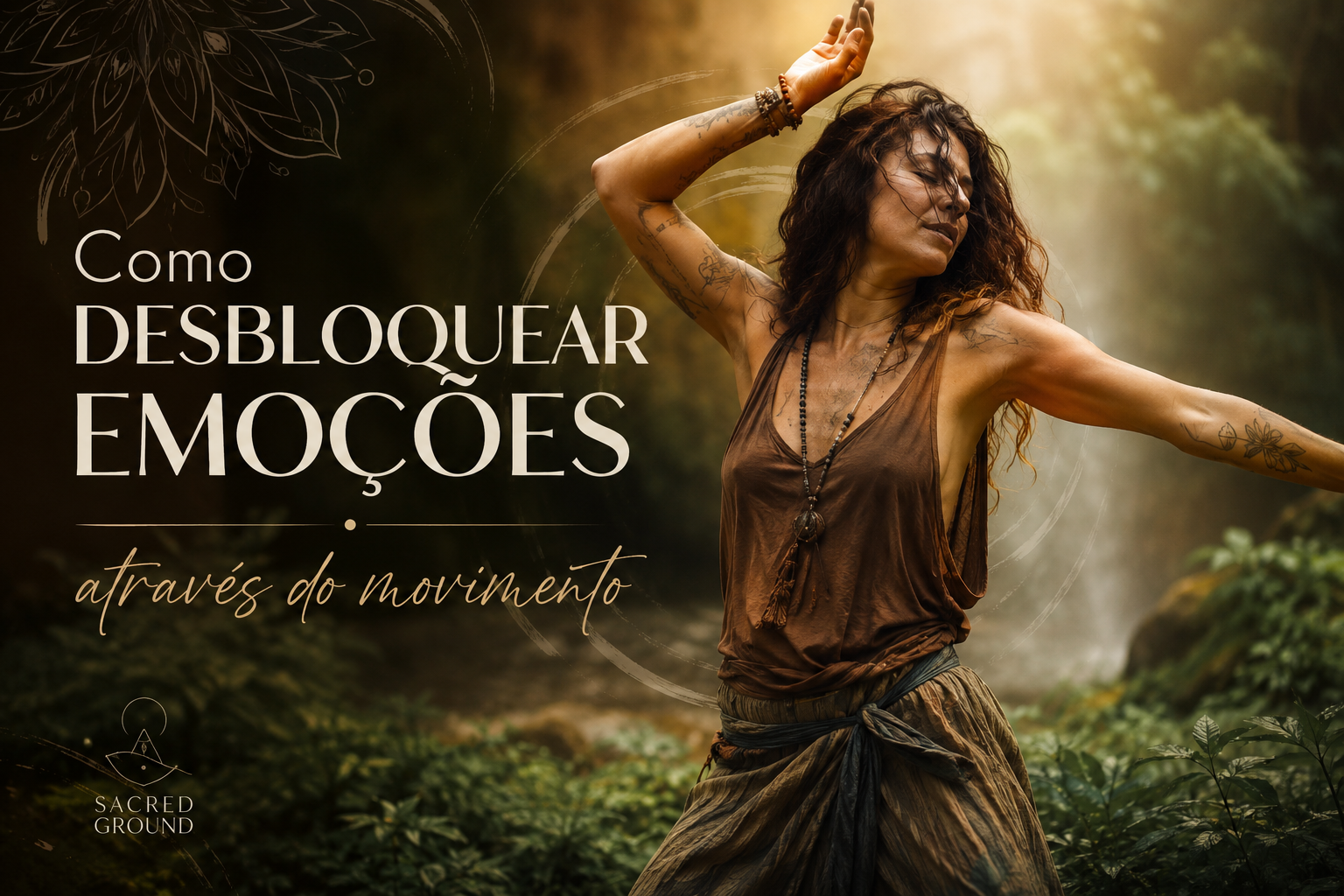
There are moments when words fall short. When what we feel is too vast to fit in a sentence, too ancient to have a name. In those moments, the body speaks — and dance becomes language.
The Body as Emotional Archive
Much of what we experience is stored in the body. The tightness in the chest after a loss. The stiffness in the shoulders when we carry too much. The lightness in the legs when we feel joy. The body doesn’t forget — it records, layer by layer, everything the mind sometimes prefers to ignore.
Research in neuroscience and psychosomatics has been confirming what ancient healing traditions already knew: emotions don’t live only in the mind. They inhabit tissues, muscles, breath. And that’s why movement holds a unique power — not just to make us feel good in the moment, but to help us release what has been trapped.
Dancing Without Destination
When we dance without choreography — without right or wrong steps — something shifts. The analytical mind that judges and controls begins to give way. The body starts to trust its own rhythm. And in that space of surrender — between one beat and the next — emotions that were dormant begin to surface.
It’s not always comfortable. Sometimes it’s joy that bursts out without apparent reason. Other times it’s sadness that finally finds its way out. Sometimes it’s simply inner silence — a peace that can’t be explained, but is instantly recognised.
Music as a Guide
The right music makes all the difference. A well-crafted set isn’t just a sequence of sounds — it’s an intentional journey. It begins slowly, invites the body to awaken, builds tension and resolution, creates moments of expansion and of gathering inward. Like emotions themselves, good music has dynamics, texture, and soul.
That’s why every Sacred Ground set is curated not just to make people dance — but to create space. Space to feel. To let go. To arrive at something real.
Three Simple Ways to Begin
You don’t need a festival or a dance floor to start exploring movement as an emotional tool. Here are three accessible practices:
- Free movement at home: Choose a song that moves you (literally). Close your eyes. Let your body respond without worrying about how it looks. Five minutes is enough to begin.
- Conscious dance: Move while paying attention to what you feel as you dance. Which parts of the body move with ease? Which ones resist? That awareness is, in itself, an act of healing.
- Sharing in community: Dancing in a group, even in silence, has an amplifying effect. The presence of others, the shared rhythm, the collective breath — all of this creates a field of safety where release happens more naturally.
What Remains After Dancing
Those who have been to a conscious dance session or a well-curated music set know what we’re talking about. There’s a different quality to the silence that remains afterwards. A sense that something has been moved — not just in the body, but within.
It’s not magic, though it feels like it. It’s simply what happens when we give the body what it needs: space, rhythm, and permission to be.
At Sacred Ground, every experience is created with this intention. If you feel it’s time to release something you’ve been carrying for too long — the dance floor might be the right place to start.